Network Futures CoLab
The 21st century's biggest challenges all require co-operation. So why is our infrastructure for it still an afterthought?
Building the next generation of co-operation infrastructure — technology, finance, legal, social, and narrative.

Our Inquiry
How Do We Make Co-operation Painless?
Climate, health, equity, biodiversity — the defining challenges of this century are complex, interconnected, and unsolvable by any single organisation. They require sustained co-operation across sectors, geographies, and disciplines.
We invest billions in the problems themselves while treating the infrastructure for working on them together as an afterthought. Networks get goodwill and grant cycles. Markets get engineering.
But closing that gap isn't just about building more infrastructure for co-operation as we know it. The challenges themselves are moving targets — complex, adaptive, shape-shifting. We need co-operation that can do the same.


A network is a diagram — nodes, edges, signal flowing through static structure. Useful, but incomplete.
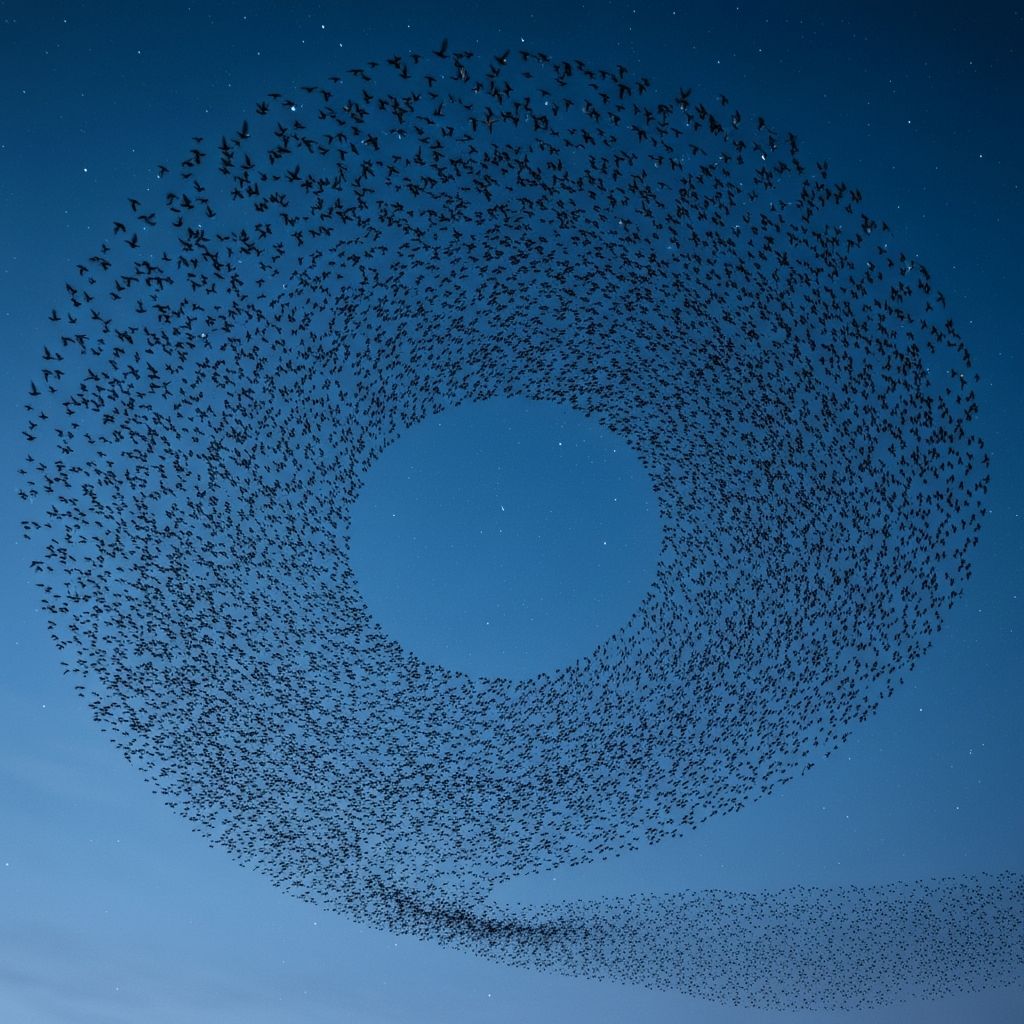
A murmuration is alive. Every bird senses its neighbours, adapts in real time, and moves as part of a whole that no single bird controls. The shape emerges. The shape evolves. The flock learns by flying.
That's the kind of co-operation the 21st century demands. And that's what Network Futures CoLab builds infrastructure for.
Our Approach
Five Layers of Co-operation Infrastructure
Co-operation at scale doesn't fail because people don't want to work together. It fails because the infrastructure isn't there. We work across five interconnected layers.
Technology
Tools for Network Agility
Most software is designed for organisations, not networks. We build tools that help networks operate with the agility their challenges demand — surfacing the right information, weaving people together across boundaries, and making best use of AI to support co-ordination that no single person could manage alone.
Finance
Funding Co-operation
Co-operation needs sustained resourcing, but most funding models are designed for individual organisations chasing individual outcomes. We develop financial structures that can resource networks directly — so co-operation doesn’t depend on the goodwill of a single funder or the luck of a grant cycle.
Legal
Structures That Fit
Networks don’t fit neatly into existing legal forms, and the wrong structure can quietly undermine everything a network is trying to do. We prototype legal frameworks and governance models designed for multi-stakeholder co-operation — protecting mission-alignment without creating the rigidity that kills adaptability.
Social
Relational Architecture
No amount of technology or legal structure will produce co-operation without trust. We design the social architectures, community practices, and relational protocols that build the reciprocity and mutual attunement co-operation requires.
Narrative
Rewiring the Story
The dominant narratives of change centre individual heroes and linear progress. We craft narratives that make visible what effective networks already demonstrate: intelligence is collective, adaptation is relational, and the most powerful movements have no single leader.
The Flock
Who's in the CoLab
75 practitioners, researchers, builders, and leaders working across the five layers of co-operation infrastructure. Here are a few of them.
Jayne Engle
Network Systems Change & Urban Transformation
Director of Cities for People at the McConnell Foundation, building pan-Canadian urban innovation networks. PhD researcher at McGill exploring regenerative economics, participatory governance, and what she calls 'sacred civics'—life-centered approaches to city-making through labs, transformation networks, and community-driven design.
Jane Wei-Skillern
Networked Nonprofits & Mission-Driven Leadership
Senior Fellow at UC Berkeley’s Center for Social Sector Leadership, formerly faculty at Stanford, Harvard, and London Business School. Originator of the 'networked nonprofit' framework—Mission before Organization, Trust not Control, Humility not Brand, Constellations not Stars. Two decades of research proving that trust-based collaboration outperforms institutional expansion.
Sam Rye
Systems Change & Innovation Orchestration
Systems-change practitioner building relational infrastructure that connects researchers, funders, NGOs, and communities. Creator of the Living Labs model for university-society partnerships and regional innovation orchestration. Member of the Luminary Community at Illuminate, advancing how we communicate and sustain systems change globally.
Steve Waddell
Societal Transformation & SDG Systems
Founding Lead Steward of the SDG Transformations Forum, three decades of building inter-sectoral collaborations across business, government, and civil society. Former Boston College faculty, advisor to the UN Global Compact, World Bank, and Ford Foundation. Architect of frameworks distinguishing incremental, reform, and transformational change—and the financing systems each requires.
Russ Gaskin
Collaborative Innovation & Network Weaving
Managing Member of CoCreative, designing and launching 60+ change networks that help leaders collaborate across organizational, sectoral, and political boundaries. Pioneer of frameworks that blend structured strategy with emergent learning. Former senior leader at Green America and US SIF, bringing deep roots in impact finance and triple-bottom-line networking.
Kaliya Young
Decentralized Identity & Open Protocols
Known globally as 'Identity Woman,' co-founder of the Internet Identity Workshop—the unconference that shaped OpenID Connect, OAuth, and Verifiable Credentials. World Economic Forum Young Global Leader, author of The Domains of Identity. Two decades building worldwide communities of developers, policymakers, and organizations around user-centric, decentralized identity standards.
Ben Roberts
Collaborative Funding Ecosystems
Architect of CoFundEco and Lead Steward of the r3.0 Advocation Partner Program, designing community-governed funding structures that shift decision-making power to those closest to the work. Founder of the Conversation Collaborative, building large-group dialogue infrastructure that weaves communities, networks, and movements into shared action.
Yev Muchnik
Legal Innovation & Network Governance
International attorney and legal innovator with deep roots in corporate governance, M&A, and cross-border law. Trained at Oxford, Birmingham, and GW Law, with experience spanning Allen & Overy, Squire Patton Boggs, and general counsel roles at publicly traded tech companies. Founder of ESQLEGAL, breaking traditional barriers to legal access through collaborative, community-oriented legal infrastructure.
+ 67 more across 8+ countries
The CoLab is an open network. If you see yourself in this work, get in touch.
In Flight
What We're Working On
Active prototypes, research threads, and collaborative builds happening across the CoLab right now.
Mycelial
The operating system for impact networks. Mycelial replaces the patchwork of newsletters, event tools, billing systems, and chat apps with a single integrated platform — so network organisers can focus on activating ecosystems rather than managing software.
q1 Network
A human-first collaborative network for founders, freelancers, and project organisers. q1 bundles shared infrastructure — co-working, mentorship, funding rounds, and guild-based project teams — into a high-trust ecosystem for the future of work.
Resolve
AI-enabled ecosystem mapping, network analysis, and synergy detection. Turns fragmented stakeholder data into shared intelligence that supports evidence-based decision making across networks.
CoFundEco
A collaborative funding ecosystem that pools capital across donors, project teams, and community stewards — shifting allocation power to the network itself. Built on the Blueprint 8 framework for regenerative funding governance.
FEST
Financial Ecosystems for Systemic Transformation. FEST accelerates the emerging field of financing systemic transformation — bringing together practitioners, thought leaders, and funders to develop the ecosystem-level financial infrastructure needed to resource systems change at the scale the polycrisis demands.
Learning Journey to IETF 127
A structured immersion at the Internet Engineering Task Force in San Francisco — learning from 40 years of large-scale, decentralised co-operation through rough consensus, open participation, and running code. Led by Kaliya Young.
More projects emerging.
This is a living portfolio. New workstreams are added as the CoLab grows and new collaborators join.
Why Join
Why Join the CoLab
The infrastructure is missing
The 21st century’s biggest challenges all require co-operation. But the infrastructure for co-operation barely exists. We’re building it.
The pieces exist but aren’t connected
Regenerative finance, steward ownership, agentic AI, network science, new legal forms — the building blocks of a different institutional stack are real. What’s missing is the connective tissue. The CoLab is that connective tissue.
You can’t build it alone
Co-operation infrastructure is, by definition, a collective endeavour. It requires practitioners, researchers, builders, and funders working across boundaries. The CoLab is where that happens.
Find Your Path In
Three Modes of Participation
The CoLab is organised around three modes of participation. You might start with one and move between them as your work evolves.
Understand the Future of Co-operation
For: Practitioners, researchers, funders, and leaders who want to understand where co-operation infrastructure is heading — and what it means for their work.
The co-operation landscape is evolving fast across all five layers. The CoLab is where practitioners make sense of what’s emerging — together, and at depth.
What this looks like
- Educational conversations with leading thinkers and practitioners across the five layers
- Curated synthesis of what’s emerging — connecting dots across technology, finance, legal, social, and narrative innovation
- A high-signal peer environment where you can pressure-test ideas with people working at the same level of depth
You might be
A foundation program officer exploring network-centric grantmaking. A nonprofit executive sensing that the old models aren’t working. A researcher studying collective action. A funder trying to understand what “co-operation infrastructure” even means — and whether it’s worth investing in.
Develop the Protocols and Tools
For: Designers, developers, legal architects, financial engineers, and systems thinkers who want to build the next generation of co-operation infrastructure.
Understanding the future of co-operation is necessary but not sufficient. Someone has to build it. The CoLab runs working groups and prototyping sprints focused on specific pieces of the co-operation stack — from AI agent protocols to legal templates to regenerative funding vehicles.
What this looks like
- Working groups developing open-source tools, legal templates, and protocol designs
- Active prototypes including the Pando Fund (regenerative capital), ICAN (agentic co-operation), and composable governance frameworks
- Collaborative R&D — distributed across the network, not centralised in one organisation
You might be
A developer interested in AI for co-ordination rather than extraction. A lawyer experimenting with steward ownership. A financial engineer designing instruments that fund co-operation without requiring exit. A systems designer who’s been sketching post-institutional architectures on napkins for years.
Launch and Strengthen Co-operative Networks
For: Network leaders, backbone organisation staff, and ecosystem builders who are running or launching highly co-operative networks and need practical infrastructure to make them work.
You don’t need to be convinced that networks matter — you’re already doing the work. What you need is better tooling, more sustainable funding models, governance structures that actually fit, and a peer community of people solving the same problems. The CoLab connects you to emerging infrastructure and the people building it.
What this looks like
- Peer learning with other network leaders navigating real operational challenges
- Access to emerging tools, templates, and frameworks being developed in the Build track
- Practical support for network design, governance, funding strategy, and technology adoption
You might be
A backbone org director holding a network together with duct tape and relationships. A network founder trying to figure out legal structure, sustainable funding, and governance — simultaneously. An ecosystem builder who’s been told to “just use Slack” one too many times.
Find Your Path In
Whether you're here to learn, build, or implement — the CoLab is open.
Building the next generation of co-operation infrastructure.